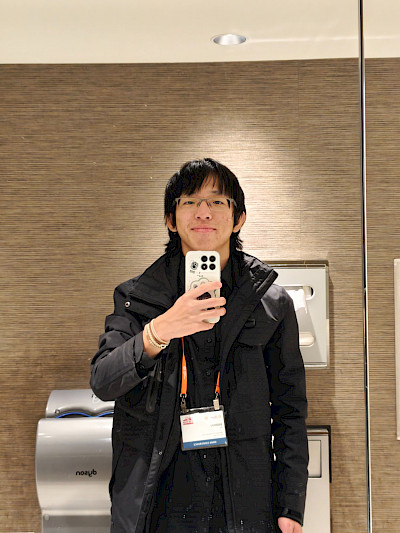
Jiuzhou Fu
Mary Gates Research Scholar
Autumn 2025
Major: Mathematics
Pronouns: He/Him
Mentor: Prof. Dongfang Zhao, University of Washington - Tacoma, Computer Science
Project
ProHD: Projection-Based Hausdorff Distance Approximation
This project develops a faster way to compare large collections of data points. A common tool for this is the Hausdorff distance, which measures how different two sets are by looking at how far their most separated points are from each other. It is widely useful in areas such as image analysis, scientific computing, and large-scale data search, but calculating it exactly can become extremely slow when datasets contain millions of points or many dimensions.
To address this problem, we developed **ProHD**, a method that first identifies a small number of especially informative or “extreme” points and then uses them to estimate the Hausdorff distance much more efficiently. Instead of comparing every possible pair of points, ProHD uses geometric projections to focus computation on the points most likely to determine the final distance. In experiments on image, physics, and synthetic datasets, ProHD was typically 10–100 times faster than exact methods while remaining very close to the true value and substantially more accurate than simple random sampling. This makes large-scale set comparison practical for applications such as vector databases, similarity search, and continuously updated data streams.
What I learned
Through this project, I learned what research is actually like. How to start question and eventually turn the work into a paper. I also learned that writing a research paper is very different from doing a class project. This is a serious stuff!
I am especially grateful to Prof. Dongfang Zhao for giving me the opportunity to work on this project and for his guidance throughout the process. He made all this possible.
More than just giving me something nice to put on my resume, this experience gave me a lot of confidence. It made me feel that I had actually done something meaningful during my four years of college, rather than simply taking classes and finishing assignments. It also made me more confident that I can continue doing research and take on harder problems in the future.
Advice for future applicants
My biggest advice is to start doing research instead of waiting until you feel completely ready. UW is unusually fortunate to have many undergraduate research opportunities across different departments and labs. Finding the first opportunity may take time and several attempts, but if you keep looking, talking to professors, and applying, there is a good chance that you will eventually find a place to start. Getting yourself into that environment and forcing yourself to seriously work on a problem is already half the battle. You do not need to know everything before you begin; much of research is learning what you need along the way.
Once you get an opportunity, I would also encourage you to aim higher than simply completing assigned tasks. Try to understand the larger problem, suggest your own ideas, and work toward something concrete, like a paper, a system, an experiment, or another result that genuinely contributes to the project. Do not assume that because you are an undergraduate, you can only be a lab “assistant.” Undergraduate researchers can take ownership of projects and make meaningful contributions. Finally, especially for STEM students, if you are unsure what skill to build next, learning more mathematics is rarely a bad investment. Strong mathematical foundations have repeatedly helped me understand new areas, reason about difficult problems, and move between theory and practical research.
More scholar profiles