
Raida Karim
Mary Gates Research Scholar
Autumn 2021
Project
Community-Based Data Visualization for Mental Well-being with a Social Robot
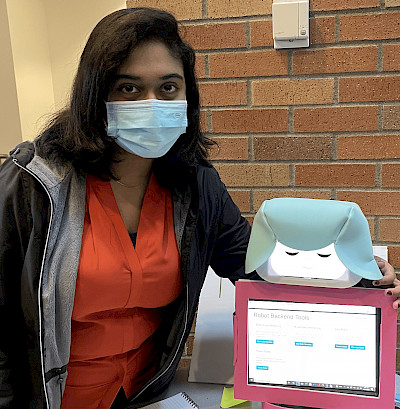
Social robots have been used to support mental health, because they are capable of forming meaningful interactions with humans due to their social intelligence, which boost user engagement with social robots. Thus, social robots can better foster emotional support with mental health data visualization compared to other technologies in collecting and displaying relevant data from humans. In this Human-Robot Interaction (HRI) research work, I explored their potential as community-based tools rendering data visualizations that represent a community’s mood patterns. Collecting and visualizing the mood patterns of a community might help its members raise awareness about their collective mental health, and whether there are significant factors negatively impacting the mental health of community members. In a two-day study, twelve participants recruited from a university community engaged with a robot displaying mood data. I created a data visualization template to show random mood data and placed it in a social robot. The design choices (e.g., spectrum of data varieties, data representation) of the template were made hypothetically in a random manner with no evidence basis from any particular community’s moods. During the study, participants were asked through verbal questions and written prompts on paper to express their feelings about robot-rendered visualizations’ usefulness in their lives. Given the feedback from participants, I modified the data visualization on the robot screen with the aim of increasing accessibility, universality, and usefulness of such visualizations. Currently, I am implementing a real-time data collection and visualization system in the robot’s end-user-programming tool. In the near future, I plan on conducting studies to assess how interacting with the robot’s automated data collection and visualization software affects users and if it produces an improved experience for them. Eventually, I hope to evaluate how data visualization enhances a sense of belonging and support among community members.